Case № 01~ 12 min read
Designing trust into a brand-new business model
In 2022, France had a million electric vehicles and only 80,000 public charging stations. Renault’s answer was peer-to-peer: unlock the 480,000 residential charging points already sitting in driveways. My job was to design a service that strangers would actually trust each other to use.
avant-propos
Plug Inn, a peer-to-peer EV charging service
01 · The challenge
Trust, without infrastructure
Peer-to-peer marketplaces usually borrow trust from connected hardware: a smart lock, a tracker, a chip in the device. Plug Inn had none of that. Just a host’s driveway, a driver’s car, and an app between them.
How do you create trust between strangers in a peer-to-peer economy when there’s no connected infrastructure to rely on?
Over two years I led the complete 0-to-1 UX: all user flows, interaction design and the functional framework. The rest of this case study zooms in on the charging experience, where real-world testing eventually led to a pivot.
02 · The users
Two strangers, opposite worries
Research surfaced two archetypes whose worries were near-mirror images of each other.
Designing trust meant addressing each one without making the other’s worse.

Host
Paul
Wants to monetise an unused charging point, but fears privacy invasion and the time commitment of strangers in his driveway.

Driver
Clara
Needs reliable charging on the road, but worries about vehicle safety and the complexity of getting in and out of someone else’s property.
the service
One journey,
Two perspectives
The Plug Inn service runs across seven steps — from searching the map to a mutual post-session rating. Both host and driver move through every phase simultaneously, but with entirely different roles and anxieties at each touchpoint.
01
Search
02
Book
03
Arrive
05
Charge
07
Depart
08
Rate
driver
Clara
Plan a week-end at the beach
Search for a compatible charging station
Request a charging session at Paul’s home
Drive to location, and park
check-inFollows charging progression
Unplug their car and leaves
check-outRates the charging station and the host
host
Paul
Shares his charging station when he isn’t home
Complete listing details and keep calendar up to date
Reviews driver’s request and approves it
Is notified charging session has started
Is notified of any anomaly
Receives session summary
Rates the driver’s punctuality & care for the equipment
Enablers
Geolocation · compatibility filter · proximity ranking
KYC · booking management system
Secured physical access · timestamped photo record
Live charging progression follow-up
Session timer · photos comparison for liability reference
Tailored rating form · dispute mediation
03.1 · For Clara, the driver
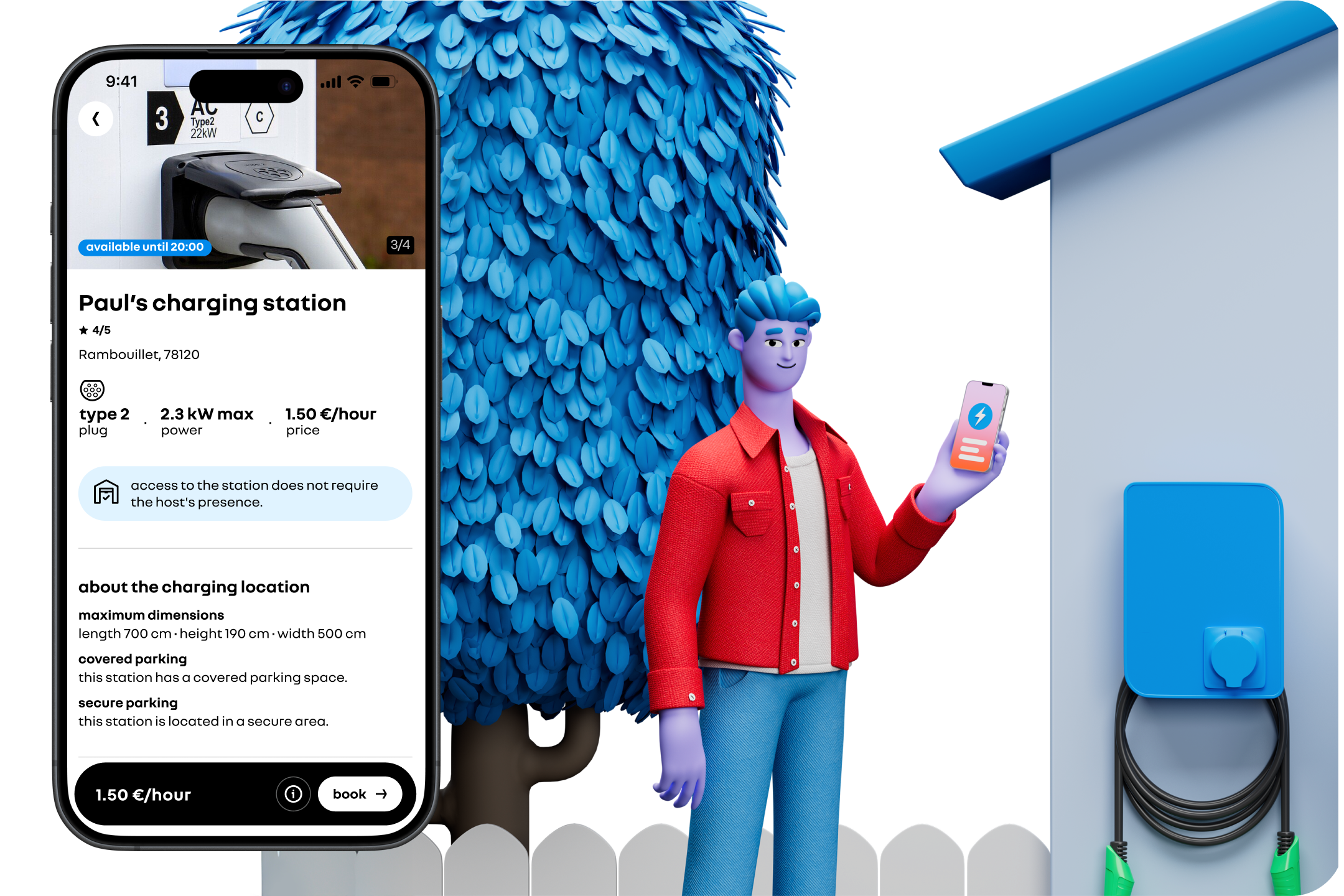
Visual transparency for decision-making
Drivers need to assess whether a charging point is compatible with their vehicle before booking. We required hosts to provide high-quality photos of the equipment, the parking space, and clear access instructions — moving the decision from gut feeling to evidence.
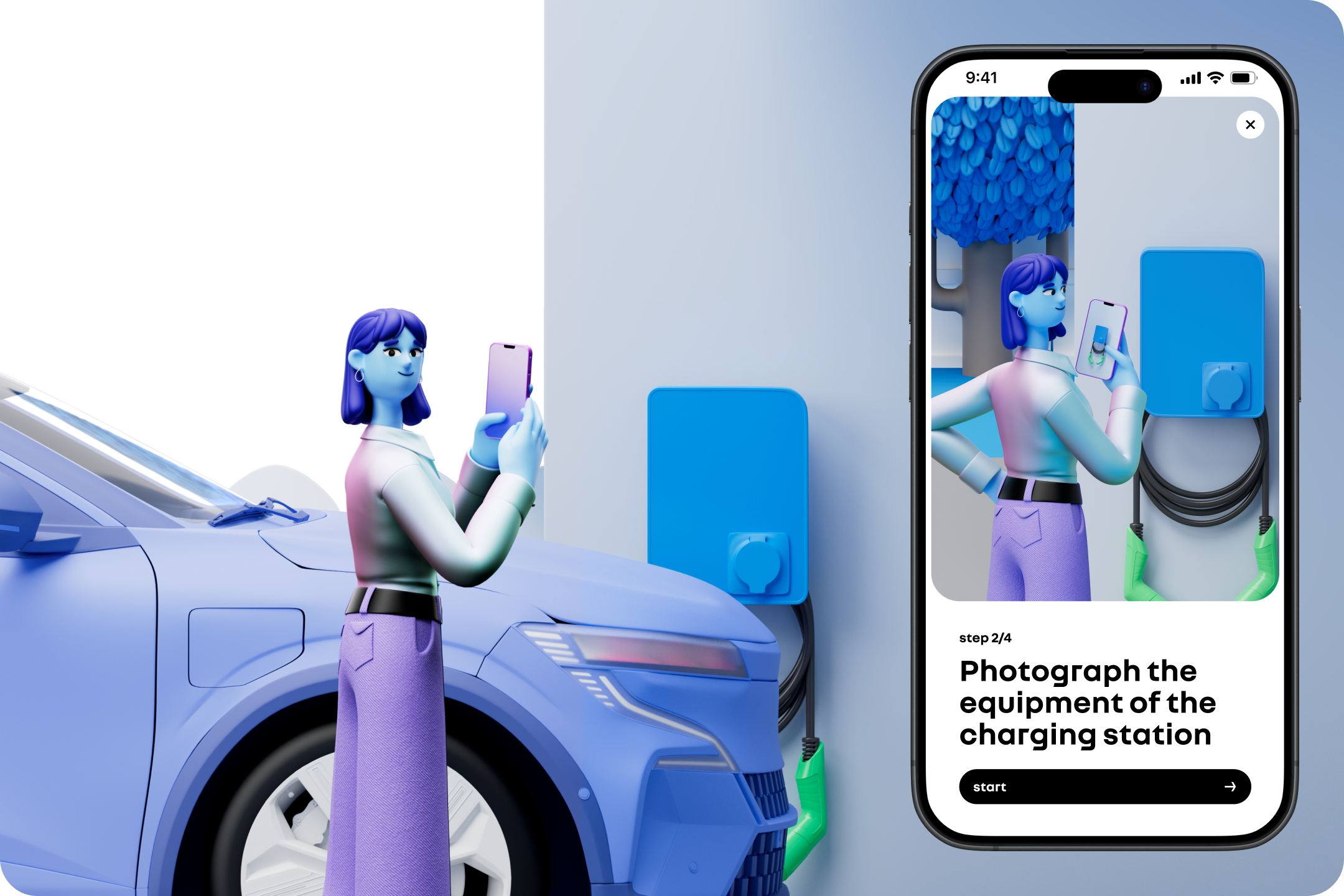
Damage liability protection
To prevent damage disputes, drivers had to complete a mandatory photo documentation of the parking-space condition and charging equipment state upon arrival and departure.
03.2 · For Paul, the host
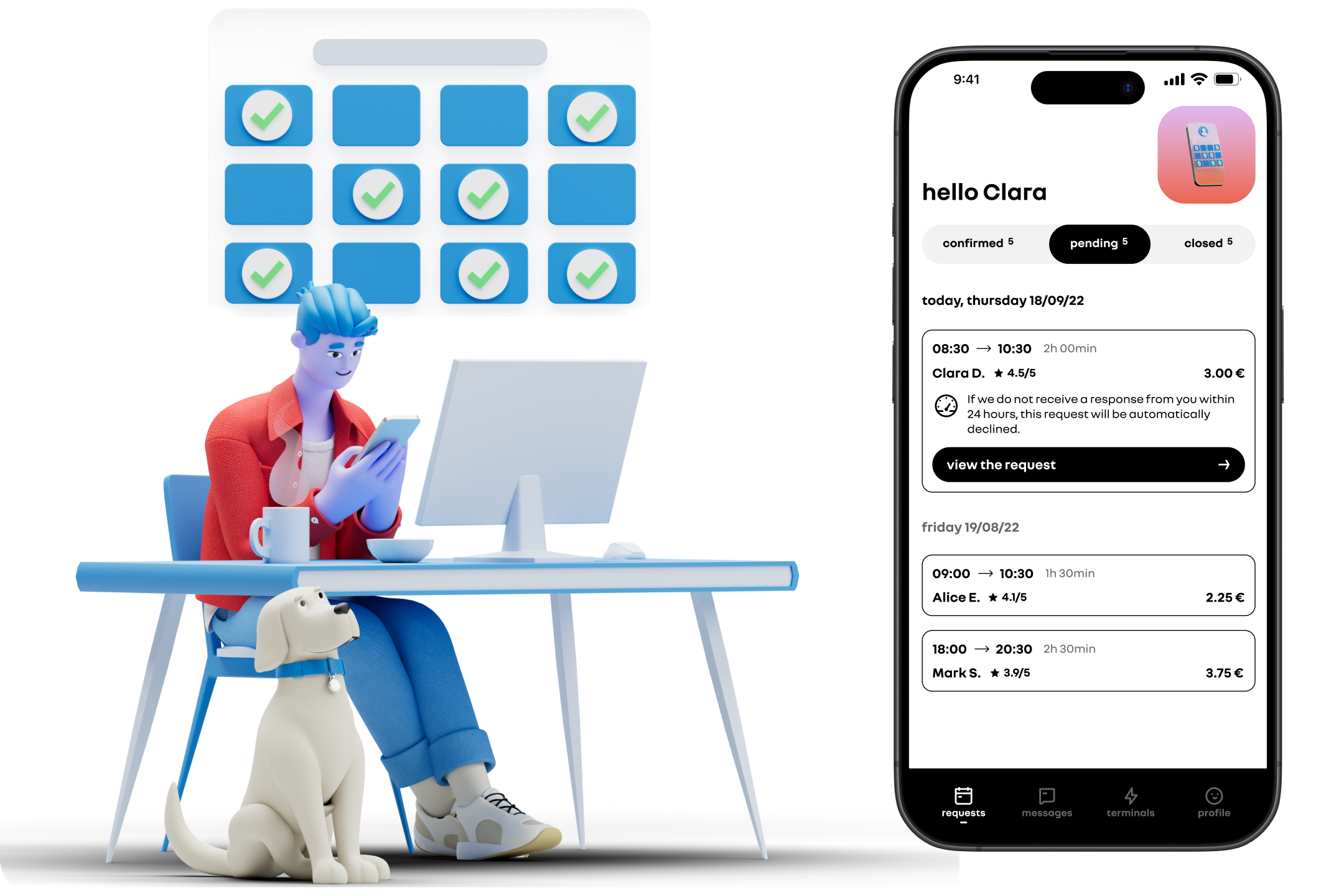
Privacy and security,
by design
To address these concerns, we implemented user verification with vehicle details and licence plates, plus reminder notifications of arrival times.
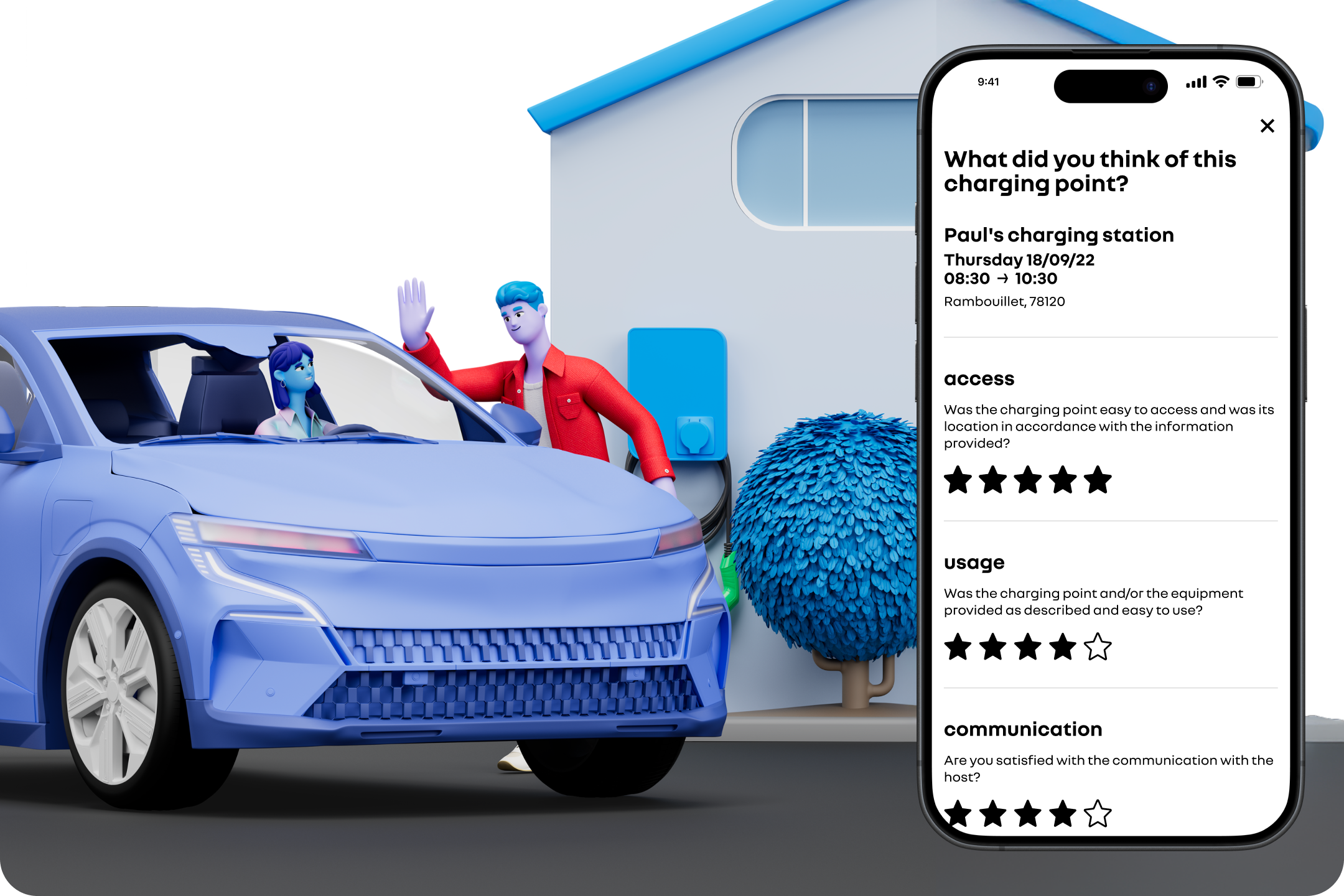
Community accountability
Bidirectional ratings with strategic reminders, on criteria drawn directly from user research. Drivers rate charging quality; hosts rate punctuality and care of the equipment; both rate communication — the most frequently cited source of anxiety on either side.
04 · Validation
Beyond screen testing
While we had tested the full user journey several times through the app, we still lacked terrain insights. Trust is a behaviour as much as it is an interaction. We tested in two phases — one in a controlled location, one out in the wild.
04.1 · Phase one — Controlled environment
5 users, our agency parking
Our main goal at that point was to ensure the check-in & check-out was logistically sound and made sense to users.
We recruited 5 users to test the charging experience in our agency car park.
Since the app hadn’t launched yet, we sent booking instructions by email, mirroring information that would be provided through the app.
- Park and turn the engine off4 users didn’t check-in
- Take a picture of the EV battery level
- Take a picture of the parking spot
- Take a picture of the charging equipment
- Plug the cable to the station and EV2 users had to turn the engine back on to start charging
Key discoveries
- The check-in flow didn’t match users’ mental modelUsers park their car and plug the cable in one go before they take out their phone.
- Each car model has a different charging workflowThe Plug Inn charging experience would have to be a compromise and wouldn’t be intuitive for all.
- The check-in/check-out was reassuring to usersDrivers regularly encounter dysfunctional equipment and worried about being accused of damaging private equipment.
follow-up
- Reordered the photo sequence to match natural behaviour.
- Added multiple reminder touchpoints and inline tutorial guidance.
04.2 · Phase two — Real-world experiment
Rented EVs,
real driveways
A few months after launch we rented EVs and booked real charging sessions, mostly in residential garages and private parking spots — the actual context of the service. Here’s what we discovered.
- 01
A few kilometres on foot
Once parked, drivers are trapped within walking distance. Activity during a session is severely limited — they will primarily book where they were already planning an extended stay. Residential areas with no amenities have very little utility.
- 02
An uncomfortable dependency
Only one of the points we tested allowed autonomous access. The others required host assistance — badges, manual gates — creating awkward intrusions into someone’s personal space.
- 03
3 out of 4 hosts weren’t there
The EV-owning host needed to be away for the spot to be free. Spouses and family handled the interaction without app knowledge — extra friction, awkward explanations between strangers.
05 · plot twist
While solving trust,
we found a deeper problem.
How do you redesign a service when the fundamental infrastructure model itself creates the friction?
Phase 2 made plain that the residential peer-to-peer model only worked under two conditions: autonomous access, and a location worth staying near. Those conditions are narrow. UX optimisation alone could not scale the service to mass adoption — the service structure itself needed to change.
06 · Strategic response
And so, we pivoted
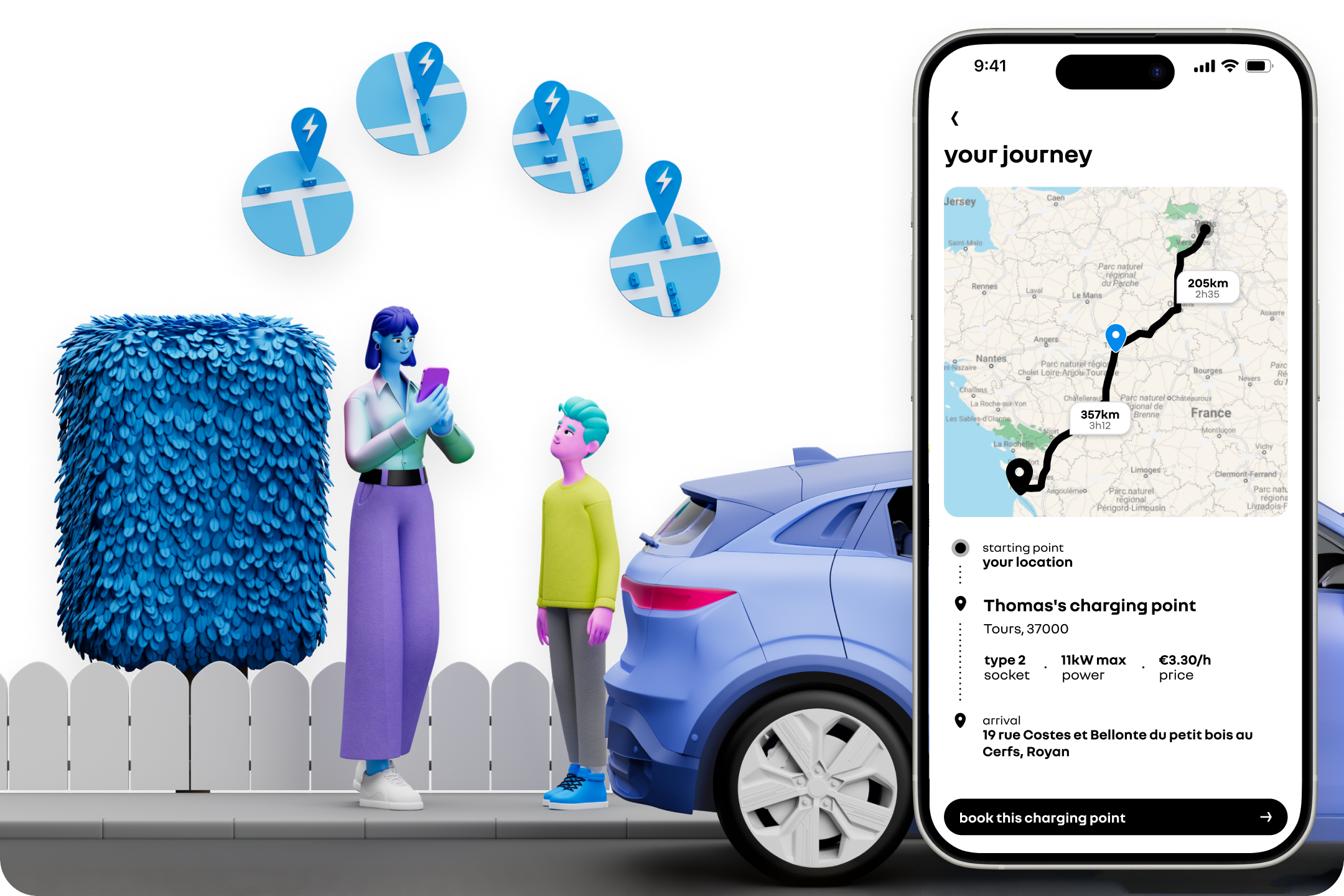
Reframe charging discovery around the actual user journey.
Integrate fast-charging options into planned trip flows — a road-planner — rather than presenting charging as an isolated transaction.
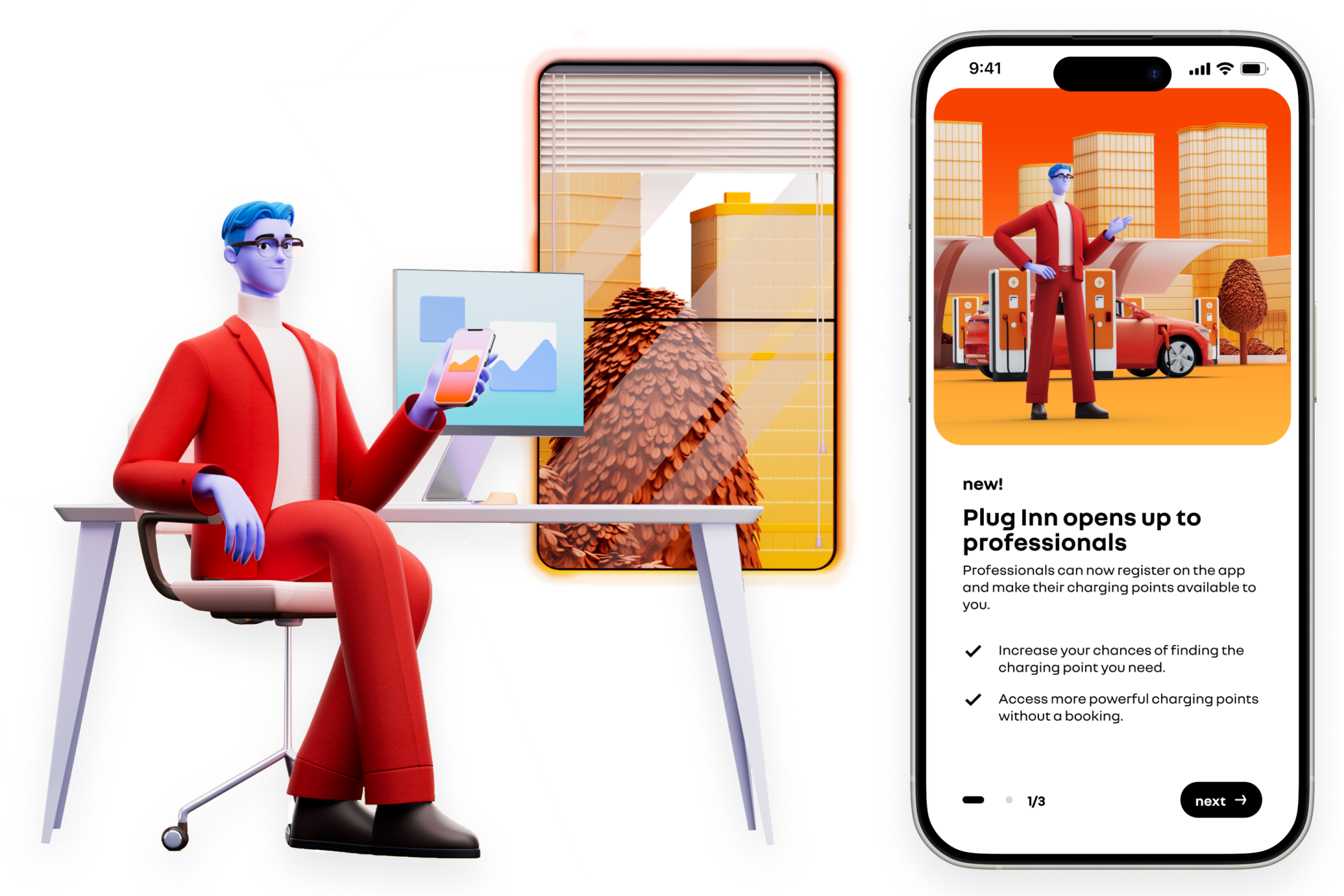
Expand from residential to professional hosts.
Hotels, restaurants and businesses where extended stays are natural. This addressed the social-friction and dependency issues at the source. An on-board (car OS) surface was also tabled to give Plug Inn points more visibility to Renault EV owners.
07 · impact
Reception, in numbers.
Plug Inn launched as planned, and met its early traction milestones — alongside broad industry recognition for the model itself.
platform reception
industry recognition
- 2023Cannes LionsGrand prize in Creative Strategy · 3 awards in Mobile and Service Design
- 2024Fast Company’s World Changing IdeasWinner, Transportation category · finalist in Apps category
- 2024Clio AwardsGrand Winner in Creative Business Transformation
08 · Takeaways
What I learnt
Some user pain points cannot be solved through UX design optimisation and require fundamental service-strategy changes. Recognising when to escalate beyond interface solutions is crucial.
Real-world testing revealed insights impossible in controlled environments, demonstrating that the most valuable UX research often challenges the initial problem definition itself.